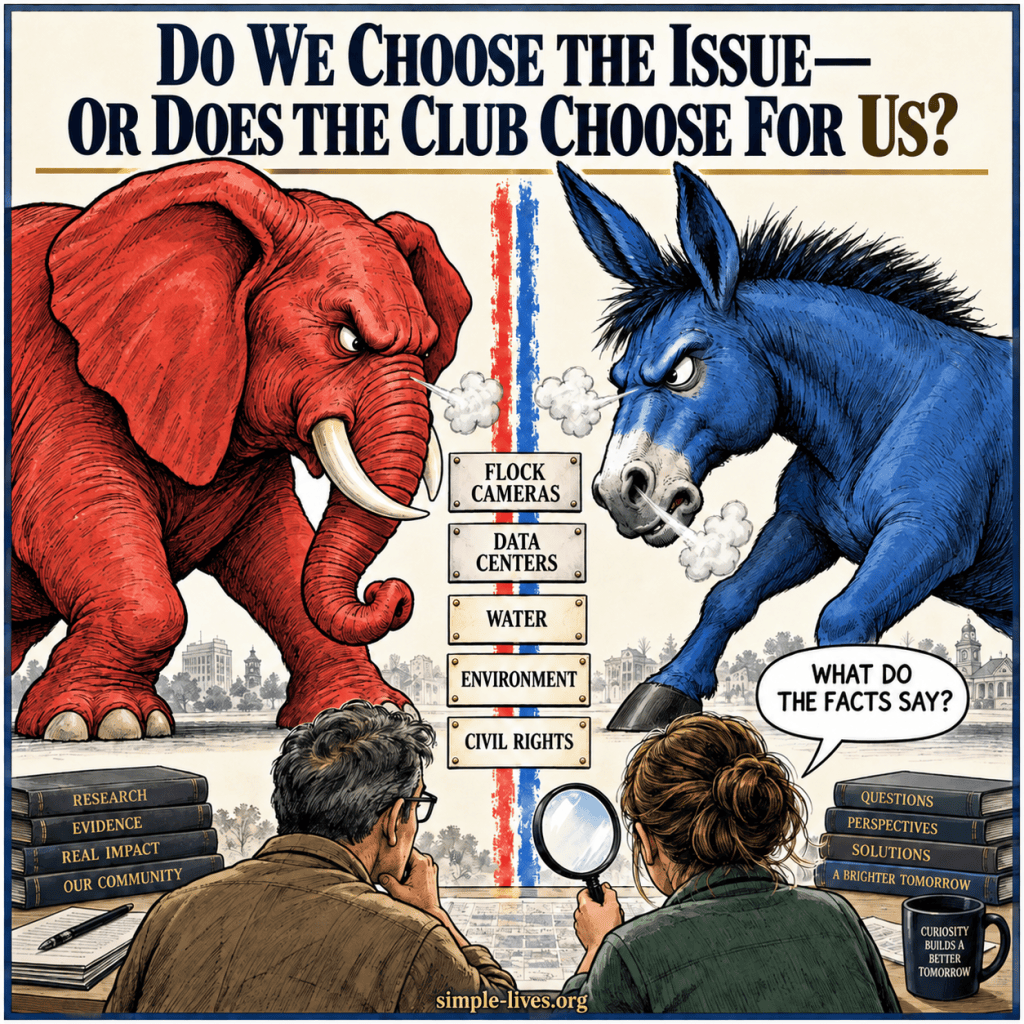
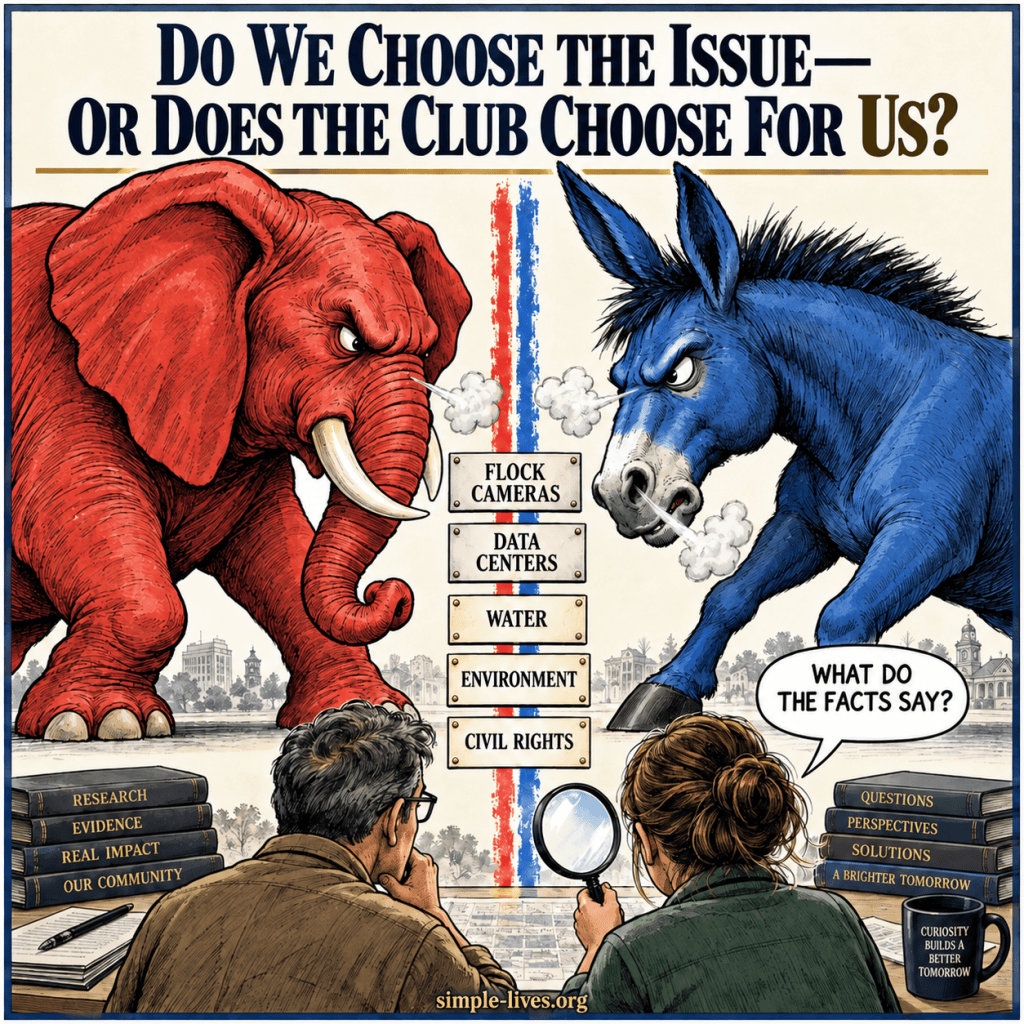
🔴 RED TEAM, BLUE TEAM: DO WE CHOOSE THE ISSUE- OR DOES THE CLUB CHOOSE FOR US? 🔵
Watch politics long enough and a peculiar pattern appears.
A new issue shows up with no obvious party color. People start asking legitimate questions. Then the leaders, the commentators, the organizations pick their sides – and before long, the whole country has sorted itself into predictable red and blue camps.
License-plate cameras become either essential crime-fighting tools or an unacceptable surveillance network.
Data centers become either economic development and technological progress or a threat to water, electricity, property and local control.
Environmental regulation becomes either responsible stewardship or government interference.
Civil-rights policy becomes either necessary protection or unfair preferential treatment.
How do millions of people, looking at the same set of facts, keep landing on opposite sides of such different issues?
The honest answer: some of it is rooted in real principle. Some of it is the club.
PARTIES ARE A SHORTCUT
Most of us don’t have time to research every camera contract, water permit, power agreement, court ruling and proposed law. So party becomes the shortcut.
If the leaders and commentators we trust say a proposal protects public safety, freedom, or working families – we believe it. If the other team endorses it, we start looking for the catch before we’ve even read it.
That doesn’t make people ignorant. It makes them human. We rely on trusted sources for almost everything in life.
The danger starts when trust turns into automatic obedience.
THE PARTIES ARE PACKAGE DEALS
Political parties are coalitions – donors, activists, industries, religious groups, labor, advocacy groups, voting blocs. These groups don’t naturally agree on everything. The party holds them together by bundling their interests into one package.
You might join a party over taxes, or abortion, or guns, or immigration, or labor rights, or healthcare. Once you’re in, you’re exposed – constantly – to that party’s preferred position on dozens of subjects that have nothing to do with why you joined.
Over time, people start adopting the whole package. Even the parts that have nothing to do with their actual values.
That’s how a local water dispute somehow becomes a loyalty test.
THE SAME ISSUE CAN HOLD COMPETING VALUES
Take Flock license-plate cameras.
Someone focused on public safety sees a tool that helps recover stolen cars and catch suspects. Someone focused on privacy sees a searchable record of where innocent people have been.
Both concerns are real.
The disagreement comes down to which risk you find more urgent: letting a criminal go, or building a surveillance system that can be misused.
And here’s the thing – this one doesn’t split neatly along party lines. National polling shows stronger Republican support for Flock cameras, yet Republican Governor Greg Abbott paused state funding for the program. Opposition in Congress has come from both sides of the aisle too.
That’s what happens when principle crosses the party line. Support for law enforcement runs straight into distrust of government surveillance.
Data centers create the same kind of collision.
One person sees jobs, investment, tax revenue, infrastructure. Another sees a massive draw on water and electricity – noise, generators, transmission lines, and the question of who actually foots the bill for the expansion.
A conservative might back business growth but oppose the government incentives, or the hit to property rights, or the loss of local control.
A liberal might back technological progress but oppose the environmental cost, or the power it hands to a handful of enormous corporations.
The closer you look, the less red or blue these issues actually are.
WATER SHOULDN’T HAVE A PARTY
Republicans, Democrats, independents – everybody needs clean, dependable water. Nobody’s arguing about that.
The argument is over how to protect it, who decides, and who pays.
Should the rules come from Washington, Austin, or the county commissioners? How much freedom should a property owner have over the water beneath their own land? Should industries pay more when their operations strain public systems? How much environmental risk is worth trading for economic growth?
Those are legitimate questions. But once “protecting water” gets branded as belonging to one party, the public loses – because now people are defending or attacking a project based on its political jersey instead of the actual numbers.
CIVIL RIGHTS ARE EVEN MESSIER
Nearly everyone says they believe in freedom, equality, fairness. The fight is over what those words actually require.
Does equal treatment mean the exact same rule for everyone, no exceptions? Does it sometimes mean correcting for old discrimination? When should government step in, and when should it stay out? How do you weigh individual liberty against protection from discrimination?
Those are questions of law, history, morality, and competing rights – and you cannot settle them with a red jersey or a blue one.
Even the parties themselves haven’t stayed put on these questions throughout history. Positions we think of as “naturally” Democratic or Republican today weren’t always sorted that way.
That alone should be a warning against mistaking a party’s current platform for eternal truth.
THE CLUB CHANGES HOW WE THINK
Research keeps finding the same thing: we scrutinize evidence that contradicts our beliefs far more aggressively than evidence that confirms them. We demand ironclad proof from the other side and accept a convenient headline from our own.
Then there’s negative partisanship – staying loyal to your team not because you love it, but because you fear or despise the other one. At that point, politics stops being about solving the problem and starts being about making sure “they” don’t win.
None of this means every claim from both sides is equally true, or every policy equally harmful. Evidence still matters. Some arguments hold up under scrutiny. Others fall apart.
It just means: check the evidence before you check the jersey.
THE CLUB TEST
A few questions that expose whether you’re standing on principle – or just defending your team:
• Would I support this exact policy if the other party proposed it?
• Would I condemn this same behavior if someone on my side did it?
• Can I actually state the strongest argument against my own position?
• What evidence would change my mind?
• Who benefits here, and who pays the cost?
• What oversight, audits, appeals, and expiration dates exist?
• Am I looking at the proposal – or reacting to who’s holding it?
These questions sting a little. That’s usually a sign they’re worth asking.
SO – IS THERE A RHYME OR REASON?
Yes.
People have different values, different experiences, different ideas about what government should and shouldn’t do. Those differences are real.
But so is the club.
Political parties tell us which risks to worry about, which experts to trust, and which compromises count as betrayal. Social media, meanwhile, rewards certainty and outrage a lot more reliably than it rewards curiosity.
We need political parties – they’re how people organize, campaign, and turn ideas into policy. But citizens should be more than fans cheering from the bleachers.
On the things that actually touch our lives – our water, our privacy, our taxes, our electricity, our property, our rights – we should be the referees, not the fans.
A good idea doesn’t become bad because the other team proposed it. A bad idea doesn’t become good because your team slapped its logo on it.
So before you pick a side, try pulling off the jerseys and asking the only question that actually matters:
What will this policy actually do – and would I still believe it if the colors were reversed?
— News, Views, Rumor & Humor
SOURCES AND FURTHER READING:
• Motivated reasoning and confirmation bias in political beliefs:
https://doi.org/10.1111/j.1540-5907.2006.00214.x
• Political identity and growing dislike of the opposing party:
https://doi.org/10.1146/annurev-polisci-051117-073034
• Negative partisanship and party loyalty:
https://www.sciencedirect.com/science/article/pii/S0261379415001857
• Reuters/Ipsos polling on public attitudes toward Flock cameras:
https://www.reuters.com/world/us/who-likes-flock-ai-cameras-reutersipsos-polled-1000-americans-find-out-2026-09-11/
• Texas pause on state funding for Flock camera systems:
https://www.texastribune.org/2026/08/28/texas-greg-abbott-flock-cameras-order-state-money/


Leave a Reply