Polk County has responded to my resubmitted request, and the answer is short: the office says it has fulfilled the request, is forwarding all available material, and that “No rugs have been purchased as of this date.
Here’s what that does and doesn’t tell us.
My original request wasn’t just about receipts. I asked for all communication, costs, quotes and budget, plus any commissioner approval (paraphrased not quoted here). I narrowed it only after the county put a price tag of 108 hours and $1,600+ on it. A receipt can only exist after a purchase. Quotes, budget lines, emails and approvals can exist long before one.
So “no rugs purchased” answers the narrow question. It doesn’t answer the one I started with: was money set aside, quoted or approved for rugs, and by whom?
I hear that more may be revealed at an upcoming Polk County Commissioners Court meeting. 👀
I’m not drawing conclusions about the $80,000 rumor until I see the documents, and what’s not in them matters as much as what is.
A message dinged on Bethany’s phone. A friend from a neighboring county had caught wind of a rumor: Polk County had spent $80,000 on rugs for the courthouse renovation.
Surely not, she thought.
The next day, another message, from someone else. “I heard the county spent $80k on rugs for the courthouse.”
Mind you, this is the same courthouse that has already blown past its budget by an estimated $7 million. So the whispers weren’t exactly new. They’d been landing in the inboxes of anyone who bothered to question the process, ongoing.
But Bethany has learned, the hard way, to collect evidence before she assumes, jumps to conclusions, or believes something just because. So the prudent move was to go straight to the source. What, exactly, had Polk County, Texas spent on rugs for its “new” old courthouse?
She drafted a request for all records pertaining to rug purchases and sent it off to the county.
The public information officer answered her email request with something absolutely astounding, and it wasn’t the answer she had hoped for.
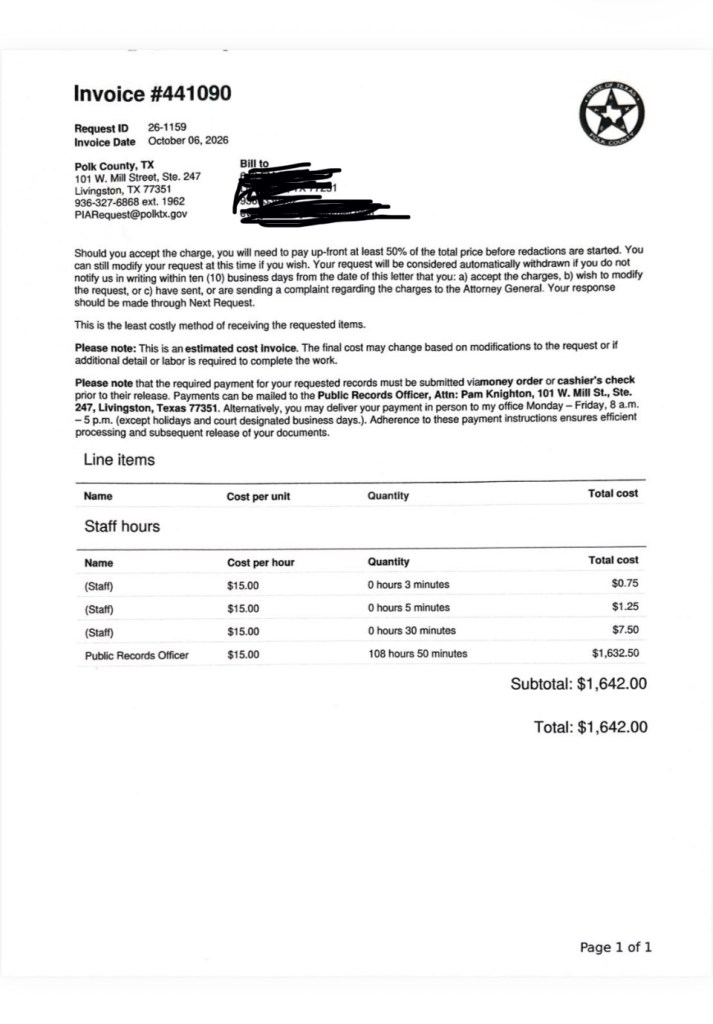
To find out who picked out, approved, and paid for the rugs, and what they cost in total, she was sent a response stating that to produce these documents, a county employee would need to spend 108 hours and 50 minutes gathering that information, and Bethany would pay the tab up front.
A $1,642.00 tab, to be exact.
No answers unless she pays for nearly 109 hours of county employee time “records searching” just to be emailed an amount and an explanation of how they got there- IF any rugs had even been purchased yet.
Needless to say, Bethany was disappointed. How can anyone give accurate information to refute rumors when the truth sits behind a price tag that equals an entire year of life insurance payments for some families?
In case you haven’t figured it out by now, this story is about me. Bethany is me, the one who pokes, prods, and questions. Sometimes just because I can, but mostly because I want the truth and I want to understand what is actually going on in my county.
So the facts I do have, are provided below- here’s the estimate I refused, and I have submitted a new request. Much simpler this time:
Just show me the receipts.
—Bethany Evans
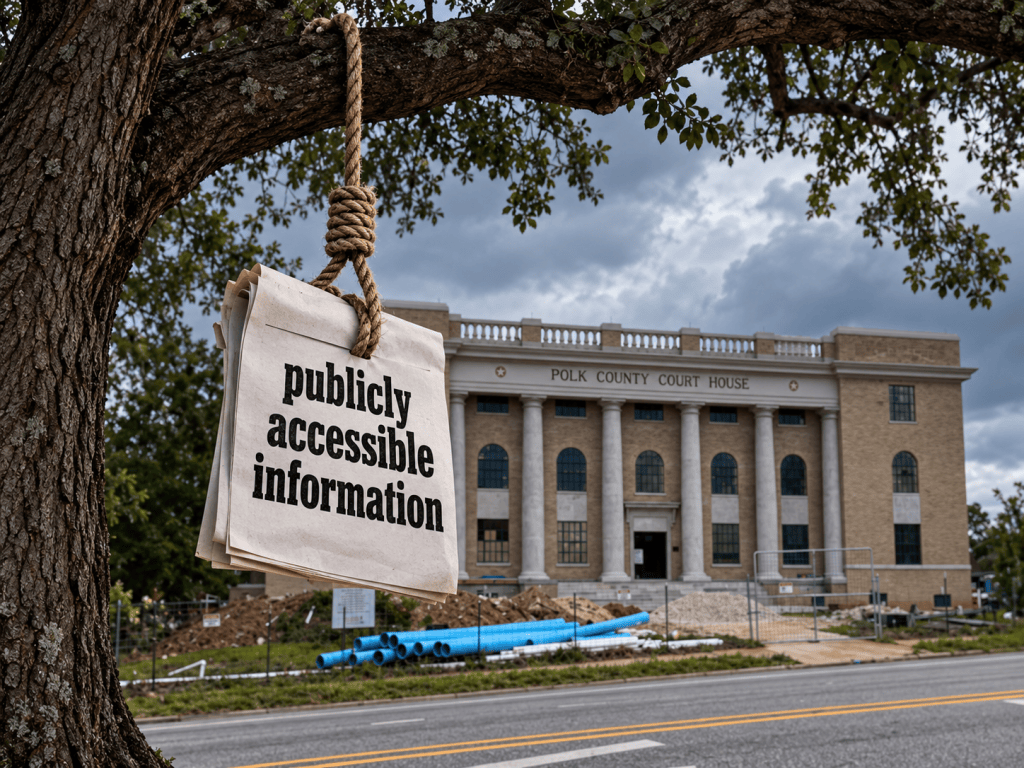
Publicly accessible information is now a thing of the past.
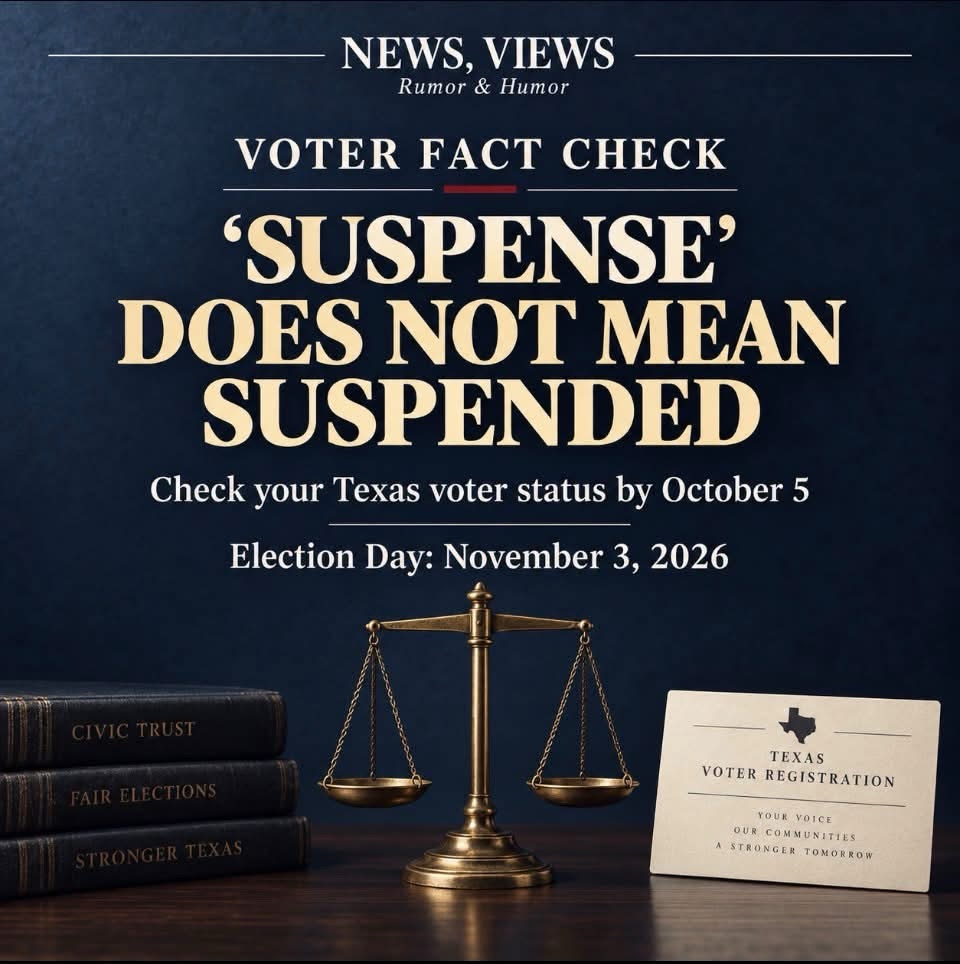
A claim circulating on social media for the past few weeks suggests that more than 1.2 million Texas voters listed in “suspense” status have been suspended from voting. That claim is false.
A “suspense” designation generally means election officials need the voter to confirm or update a residential address- often because official election mail was returned possibly as undeliverable. However, it does not automatically mean the voter’s registration was canceled or that the person cannot vote.
Still, voters should not ignore the designation.
✅ Check your registration status- ✅ Confirm that your name and address are correct- ✅ Update your information if you recently moved- ✅ Contact the Polk County Clerk with questions about your local records-
Monday, October 5, 2026, is the deadline to register or update voter-registration information for the November 3 election.
Polk County voter-registration questions:
Polk County Clerk Schelana Hock 101 W. Mill Street, Suite 265 Livingston, Texas 77351 (936) 327-6805
Official registration information link and sources provided in comments. 👇🏻
Facts do not belong to either political party. Check your status, correct any problems and make sure your voice can be counted.
🔴 RED TEAM, BLUE TEAM: DO WE CHOOSE THE ISSUE- OR DOES THE CLUB CHOOSE FOR US? 🔵
Watch politics long enough and a peculiar pattern appears.
A new issue shows up with no obvious party color. People start asking legitimate questions. Then the leaders, the commentators, the organizations pick their sides – and before long, the whole country has sorted itself into predictable red and blue camps.
License-plate cameras become either essential crime-fighting tools or an unacceptable surveillance network.
Data centers become either economic development and technological progress or a threat to water, electricity, property and local control.
Environmental regulation becomes either responsible stewardship or government interference.
Civil-rights policy becomes either necessary protection or unfair preferential treatment.
How do millions of people, looking at the same set of facts, keep landing on opposite sides of such different issues?
The honest answer: some of it is rooted in real principle. Some of it is the club.
PARTIES ARE A SHORTCUT
Most of us don’t have time to research every camera contract, water permit, power agreement, court ruling and proposed law. So party becomes the shortcut.
If the leaders and commentators we trust say a proposal protects public safety, freedom, or working families – we believe it. If the other team endorses it, we start looking for the catch before we’ve even read it.
That doesn’t make people ignorant. It makes them human. We rely on trusted sources for almost everything in life.
The danger starts when trust turns into automatic obedience.
THE PARTIES ARE PACKAGE DEALS
Political parties are coalitions – donors, activists, industries, religious groups, labor, advocacy groups, voting blocs. These groups don’t naturally agree on everything. The party holds them together by bundling their interests into one package.
You might join a party over taxes, or abortion, or guns, or immigration, or labor rights, or healthcare. Once you’re in, you’re exposed – constantly – to that party’s preferred position on dozens of subjects that have nothing to do with why you joined.
Over time, people start adopting the whole package. Even the parts that have nothing to do with their actual values.
That’s how a local water dispute somehow becomes a loyalty test.
THE SAME ISSUE CAN HOLD COMPETING VALUES
Take Flock license-plate cameras.
Someone focused on public safety sees a tool that helps recover stolen cars and catch suspects. Someone focused on privacy sees a searchable record of where innocent people have been.
Both concerns are real.
The disagreement comes down to which risk you find more urgent: letting a criminal go, or building a surveillance system that can be misused.
And here’s the thing – this one doesn’t split neatly along party lines. National polling shows stronger Republican support for Flock cameras, yet Republican Governor Greg Abbott paused state funding for the program. Opposition in Congress has come from both sides of the aisle too.
That’s what happens when principle crosses the party line. Support for law enforcement runs straight into distrust of government surveillance.
Data centers create the same kind of collision.
One person sees jobs, investment, tax revenue, infrastructure. Another sees a massive draw on water and electricity – noise, generators, transmission lines, and the question of who actually foots the bill for the expansion.
A conservative might back business growth but oppose the government incentives, or the hit to property rights, or the loss of local control.
A liberal might back technological progress but oppose the environmental cost, or the power it hands to a handful of enormous corporations.
The closer you look, the less red or blue these issues actually are.
The argument is over how to protect it, who decides, and who pays.
Should the rules come from Washington, Austin, or the county commissioners? How much freedom should a property owner have over the water beneath their own land? Should industries pay more when their operations strain public systems? How much environmental risk is worth trading for economic growth?
Those are legitimate questions. But once “protecting water” gets branded as belonging to one party, the public loses – because now people are defending or attacking a project based on its political jersey instead of the actual numbers.
CIVIL RIGHTS ARE EVEN MESSIER
Nearly everyone says they believe in freedom, equality, fairness. The fight is over what those words actually require.
Does equal treatment mean the exact same rule for everyone, no exceptions? Does it sometimes mean correcting for old discrimination? When should government step in, and when should it stay out? How do you weigh individual liberty against protection from discrimination?
Those are questions of law, history, morality, and competing rights – and you cannot settle them with a red jersey or a blue one.
Even the parties themselves haven’t stayed put on these questions throughout history. Positions we think of as “naturally” Democratic or Republican today weren’t always sorted that way.
That alone should be a warning against mistaking a party’s current platform for eternal truth.
THE CLUB CHANGES HOW WE THINK
Research keeps finding the same thing: we scrutinize evidence that contradicts our beliefs far more aggressively than evidence that confirms them. We demand ironclad proof from the other side and accept a convenient headline from our own.
Then there’s negative partisanship – staying loyal to your team not because you love it, but because you fear or despise the other one. At that point, politics stops being about solving the problem and starts being about making sure “they” don’t win.
None of this means every claim from both sides is equally true, or every policy equally harmful. Evidence still matters. Some arguments hold up under scrutiny. Others fall apart.
It just means: check the evidence before you check the jersey.
THE CLUB TEST
A few questions that expose whether you’re standing on principle – or just defending your team:
• Would I support this exact policy if the other party proposed it?
• Would I condemn this same behavior if someone on my side did it?
• Can I actually state the strongest argument against my own position?
• What evidence would change my mind?
• Who benefits here, and who pays the cost?
• What oversight, audits, appeals, and expiration dates exist?
• Am I looking at the proposal – or reacting to who’s holding it?
These questions sting a little. That’s usually a sign they’re worth asking.
SO – IS THERE A RHYME OR REASON?
Yes.
People have different values, different experiences, different ideas about what government should and shouldn’t do. Those differences are real.
But so is the club.
Political parties tell us which risks to worry about, which experts to trust, and which compromises count as betrayal. Social media, meanwhile, rewards certainty and outrage a lot more reliably than it rewards curiosity.
We need political parties – they’re how people organize, campaign, and turn ideas into policy. But citizens should be more than fans cheering from the bleachers.
On the things that actually touch our lives – our water, our privacy, our taxes, our electricity, our property, our rights – we should be the referees, not the fans.
A good idea doesn’t become bad because the other team proposed it. A bad idea doesn’t become good because your team slapped its logo on it.
So before you pick a side, try pulling off the jerseys and asking the only question that actually matters:
What will this policy actually do – and would I still believe it if the colors were reversed?
Freedom of speech was never meant to protect only the agreeable words, the flattering reports, the comfortable opinions that make everyone feel good. It matters most- when someone says the thing people, especially people in authority, don’t want said.
In a small Texas town, a self-made watchdog and social media influencer using the page Southern Belle Watch, Jennifer Combs, raised concerns about Trinidad’s discolored, dirty, and at the time- plausibly contaminated water. A question any resident has every right to ask- one we all might ask, if we lived there.
Instead of an answer, instead of transparency, instead of evidence, she got a felony charge. Jennifer spent nearly 24 hours in jail just for asking about the water.
However, a grand jury declined to indict her- and she walked out, released, and justly so. The judge who signed off on the arrest warrant said police left out “important information” when they made their case- read that again. Police LEFT IT OUT, not lost it, not forgot it: they withheld information. Environmental officials later confirmed what Jennifer had been asking about all along: Trinidad’s water system did have disgusting problems.
Now, after a separate state investigation, the Texas Commission on Law Enforcement has effectively shut their local police department down. TCOLE said the agency “failed to meet minimum standards” and couldn’t even show it “provides public benefit to the community.” No bulletproof vests. No evidence room. Nearly two dozen required policies missing entirely- use of force, active shooter response, vehicle pursuits, basic professional conduct policies missing. This wasn’t a department that lost its way on paperwork. This was a department that never had its house in order. Sounds kind of rogue to me.
To be fair (and I’ll always try to be fair): the department wasn’t exclusively closed because it arrested a critic. Its own broad failures condemned it. But that arrest? That’s what shone the light into the places somebody clearly wanted to stay dark.
One social media voice, Jennifer Combs, opened the door to shut down a whole deficient police department.
To be clear, freedom of speech doesn’t mean every claim made is always true. It means people get to ask, to dig, to report, to question- without wondering if the government or local law enforcement is going to use its power to shut them up or lock them up.
Sometimes people don’t like what’s reported because it’s false.
Sometimes they don’t like it because it’s TRUE, and they don’t want to face what that means.
Either way, the answer is to look for facts. Not retaliation. Not intimidation. Not an arrest.
When officials try to make the messenger the problem- we all need to start paying more attention to the message.
On August 25, 2026, the State Commission on Judicial Conduct issued a Public Admonition against 258th District Judge Travis Kitchens, who serves Polk, San Jacinto and Trinity counties. The Commission found that Kitchens failed to comply with the law and failed to maintain professional competence in the law in two separate areas of his court. Background on the judge Kitchens was elected to his first term to the 258th District Court, back in 2018, running against John Wells and Shelly Sitton. At a debate ahead of that race, all three candidates were asked whether judges should make law from the bench. Kitchens’ answer: a judge’s job is to take the facts of the law and apply them. He was elected that November and took office in January 2019. He was reelected in 2022, campaigning on his decades of legal experience- as a state prosecutor, defense attorney, civil litigator and sitting judge- and telling voters he aimed to give litigants the appropriate application of the relevant law, free of political considerations or favoritism. He won the March 2026 Republican primary for a third term, which begins in January 2027. He is currently in his second term.
The two violations-
The first involved a requirement Kitchens imposed before accepting plea agreements in criminal cases. Defendants and their attorneys were required to review four documents on Texas prison and parole procedures and sign a “Certification of Explanation of Prison and Parole Issues.” The court’s criminal docket reportedly described this as a mandatory 41-page process required before Kitchens would accept any plea bargain, including agreements involving probation rather than imprisonment. Kitchens told the Commission he believed the material might give defendants an added incentive not to violate probation, and that enforcement declined after about six months before the requirement was eventually dropped. The Commission found that imposing it constituted a failure to comply with the law regardless.
The second stemmed from a May 10, 2021, temporary-orders hearing in a family-law case. After learning that the children and their mother were quarantining due to COVID-19 exposure, Kitchens ordered both parents to get vaccinated by June 10, 2021, or provide a negative COVID-19 test within 72 hours of every visitation. Kitchens told the Commission he believed the order served the children’s best interest. The problem: Governor Greg Abbott had issued Executive Order GA-35 the month before, suspending provisions of state law to prevent government entities from compelling individuals to receive a COVID-19 vaccine under emergency-use authorization. The Commission found that Kitchens’ order violated his obligation to comply with the law that was already in effect.
The findings-
The Commission cited violations of Canon 2A, which requires judges to comply with the law, and Canon 3B(2), which requires them to maintain professional competence in the law. It concluded that Kitchens’ conduct was willful or persistent, inconsistent with the proper performance of his duties, and cast public discredit on the judiciary. The admonition is a matter of public record and is available through the State Commission on Judicial Conduct.
Death of the Pastor’s Wife — from a different angle:
Recently, my news feed was littered with opinions about the Netflix show. I’m late to the opinion-sharing table- which is unusual for me- but after contemplation I’ve typed up a few of my own thoughts.
Imagine a whole church so conditioned to the traditional authority structure that they missed the opportunity to hold the pastor accountable, which may have saved his wife’s life, his lover’s husband’s life, and- pending what happens at trial- may have saved this guy from the consequences of whatever truly transpired.
He needed intervention.
“Holding him accountable” may have looked like insisting he get individual AND couples therapy and become a secure, steady person- BEFORE he could be a pastor of a church (or continue to be). There were red flags. 🚩
Imagine being so conditioned not to question the traditional authority structure that you’d be willing to observe things that seemed a bit off, but not be curious enough to ask questions… because, you know,
“it’s not our business.”
Imagine how many men are able to hide behind authority and escape accountability because of how we have conditioned ourselves not to question the traditional leadership structure.
This is not intended to attack men- I love the strength that men bring to the table of life; male leadership can beautifully model love when implemented wisely.
Imagine how many marriages look somewhat normal to the outside world, while internally they may be bleeding out, right there in the church pews.
Again, I’m not taking this angle to point out men abusing power- I chose this angle more to highlight how few men get called out by others when they need it.
Accountability IS compassionate.
Deep down, we all know when something is off, when someone isn’t healthy. Why do we often stay silent? Why are there secular organizations that do a better job than some churches at demanding respect for women and children?
Why didn’t other men intervene on behalf of that pastor, to challenge his clearly faulty methods and leadership? It’s like no one actually cared.
Also, who is okay with a pastor’s wife being 21 years of age? C’mon, why was a whole church okay with that?
Was it all simply ignored because, from a very young age, we (those raised in Christian homes) are conditioned to follow, trust the structure, and not question leadership within the family and church?
The problem I have come to see with the approach of “do not question” is that it doesn’t work very well. Blind trust and obedience shouldn’t be applied to other people- we even do a disservice to them when we teach our children to blindly trust and obey us. We should be encouraging each other to sharpen our mental skill of reason- to think, to question, to reason; not necessarily to silently go along. This principle can be broadly applied and is wise.
Love God with all your heart and love your neighbor as yourself. Is it loving to stay silent?
After much observation of trial and error with this “trust and obey” model, I do not agree with blindly trusting any leader. I think there are many good pastors who would agree with this hesitancy, because they’re humble and discerning.
Those are the good ones- humble enough to lead others.
If you are conditioned to blindly obey, follow, submit, and stay in abuse, it’s a cult- not Christ’s Church. But that’s just my opinion after growing up in the streams of a few different denominations and observing, from personal experience, the different angles of submission taught within the Bible Belt of deep East Texas.
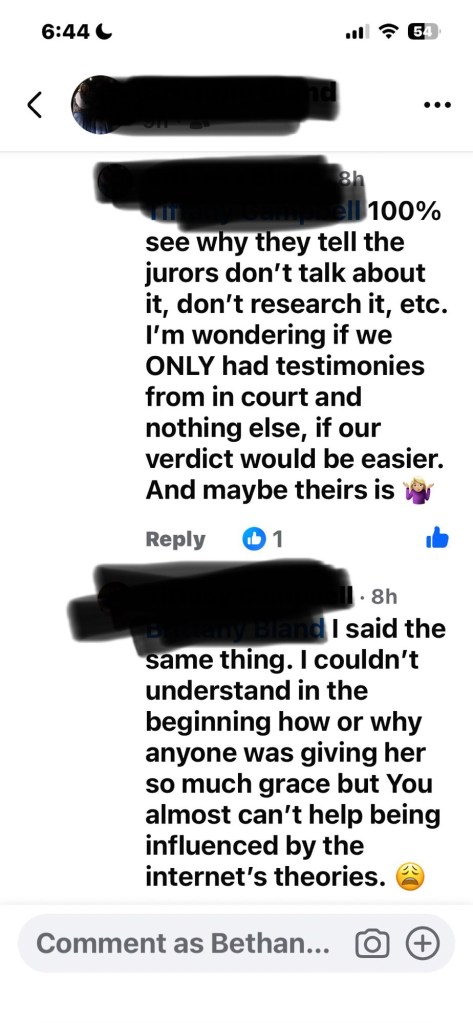
Watch the comment threads on the Lindsay Clancy trial long enough and you’ll see it happen in real time— people who will never sit on that jury, admitting outright that the internet theories shaped how they read the testimony. Not evidence. Theories. And they said so themselves.
That should hit closer to home than we want it to.
When someone’s caught up in a pending criminal case, a lawsuit, a custody battle, whatever it is— there’s this pull to just tell your side. Especially once the rumors start circulating and you can feel people forming opinions about you that aren’t true. I get that. I’ve felt that pull myself.
But posting more doesn’t protect you. It doesn’t strengthen your case.
It may do the opposite.
Here’s what that “harmless” post could actually be doing:
Shaping the opinions of people who may end up in your local jury pool.
Handing opposing counsel a transcript to pick apart for inconsistencies.
Revealing strategy— or information the other side didn’t have yet.
Letting witnesses’ memories drift toward each other instead of staying their own.
Becoming evidence, or at least the trail that leads attorneys straight to it.
Wrecking your credibility the moment an emotional post contradicts your later testimony.
Living on in screenshots long after you’ve deleted the original.
Let me be clear about what I’m NOT saying. I’m not saying every Facebook post becomes admissible evidence. I’m not saying jurors are out there researching cases— they’re not allowed to, and that’s a different problem entirely. What I am saying is simpler than that: once something enters a community’s social-media bloodstream, you don’t get to control who drinks from it, or how it changes them.
In a small community, your followers, your critics, the witnesses, and the future jury pool are not four separate groups.
Sometimes, they’re the very same people.
Before you try your case in the court of public opinion, remember something— that court has a way of eventually supplying the very people who end up sitting in the jury box.
Sources for digging deeper:
Irvin v. Dowd (1961) — the Supreme Court case that first established pretrial publicity as a fair trial issue