Court order bars outgoing Judge Sydney Murphy and county staff from destroying records tied to pending litigation as a transfer of power nears
By Bethany Evans, NVRH
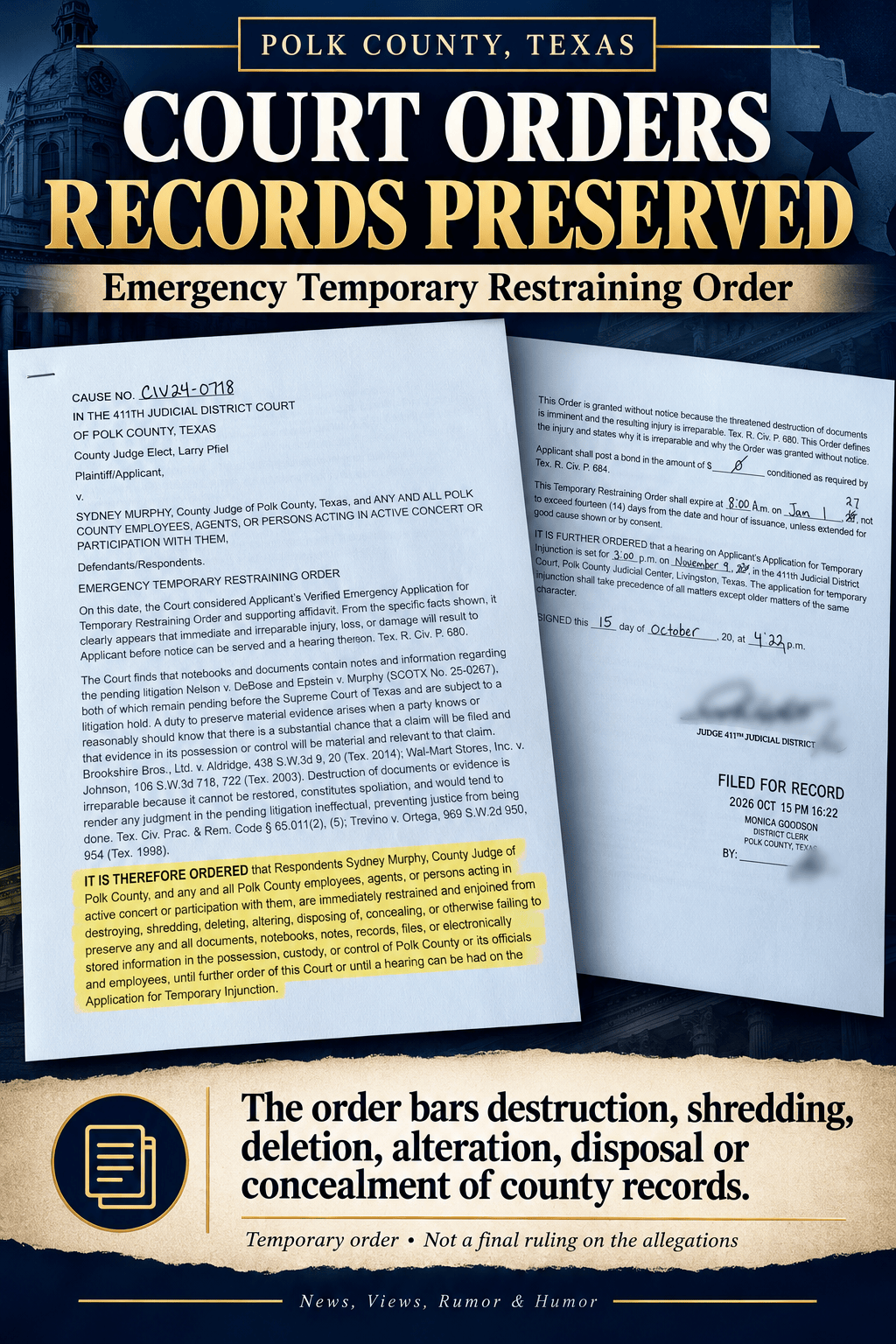
LIVINGSTON, Texas — A state district judge on Oct. 15 granted an emergency order barring outgoing Polk County Judge Sydney Murphy, and any county employees acting with her, from destroying, deleting or disposing of county records, according to a copy of the order reviewed by NVRH.
The temporary restraining order was sought by County Judge-elect Larry Pfeil, who won the primary, was unopposed in the November general election and takes office Jan. 1. It was filed in the 411th Judicial District Court and says notebooks and documents in county possession contain notes and information tied to two separate cases pending before the Texas Supreme Court that are subject to a litigation hold.
The court granted the order without notice to Murphy, finding that the threatened destruction was imminent and could not be undone. The order is temporary, and the court has set a future hearing to decide whether to keep the preservation requirement in place while the case proceeds. Pfeil said that although the restraining order was signed, he was required to return to court to file an original petition and resubmit his request for a restraining order, which is pending. It is not yet known for sure whether the court is treating the first order as superseded or inactive while that request is pending. A response from Murphy had not been obtained at the time of publication, and she has not yet been heard in court on the matter.
The dispute raises a question that comes up whenever one elected official hands an office to another: who protects the county’s paper trail in between?
How It Started
Pfeil’s court filing says the dispute began months earlier. On July 8, he hand-delivered a letter to District Attorney Shelly Sitton asking her office to remind all county officials and employees of their duty to preserve public records during the leadership transition. The letter singled out records of the County Judge’s Office, including emails, text messages, messaging-app communications, notes and records on personal devices used for county business. It also asked that routine or automatic deletion be suspended as necessary.
It is not clear from the filing whether Sitton’s office issued guidance in response.
On Oct. 15, according to the filing, Pfeil learned that a document-shredding truck was parked at the county judge’s office. He went to investigate and says he found a garbage bag of documents in a dumpster in the office parking lot. In the petition, it is alleged that the documents were potentially subject to the litigation hold and to records-retention rules. That account comes from Pfeil’s filing and inquiries made by NVRH.
Why Records Matter in a Handoff
Records created in a county judge’s office, including emails, text messages, notes, contracts, spending records and meeting materials, document how public money was spent and how decisions were made. Under Texas law they belong to the county and the public, not to the person who holds the office at the moment. An incoming judge inherits responsibility for answering public information requests, audits and lawsuits, often about decisions made before taking office, and cannot do that if the files are gone.
The restraining order makes a similar point in legal terms. It says destroying documents or evidence is irreparable because it cannot be restored, and that it could leave a judgment in pending litigation ineffectual.
A transition is a point of vulnerability. The outgoing official controls the office and its files, while the successor, not yet in office, has no authority over them. Pfeil’s filing asks the court to close that gap.
What the Law Says
The Texas State Library and Archives Commission sets minimum retention periods for local government records, and the Local Government Records Act governs when they may be destroyed. Destroying records that are already eligible under those schedules is lawful, so the shredding of some documents would not by itself signal wrongdoing.
The rules change once records are tied to litigation. Pfeil’s petition cites Texas Local Government Code § 202.002, which he says bars destroying records the custodian knows are involved in litigation until it is resolved. The restraining order also cites Texas Supreme Court decisions holding that a duty to preserve evidence arises when a party knows or should know there is a substantial chance of a claim, and it treats destruction of such evidence as spoliation.
Separate state laws make it a crime to unlawfully destroy or tamper with public information or governmental records, with penalties that vary with intent. Nothing in the order or the filing alleges that criminal conduct has occurred.
What Happens Next?
The court will decide at a future hearing whether to extend the preservation requirement while the case moves forward. Murphy remains in office until Jan. 1, when Pfeil is scheduled to take over the county judge’s office.
NVRH will update this story as more information becomes available.


Leave a Reply